
Are You Developing Taste or Performing It?
Field Notes: The Taste Trap.

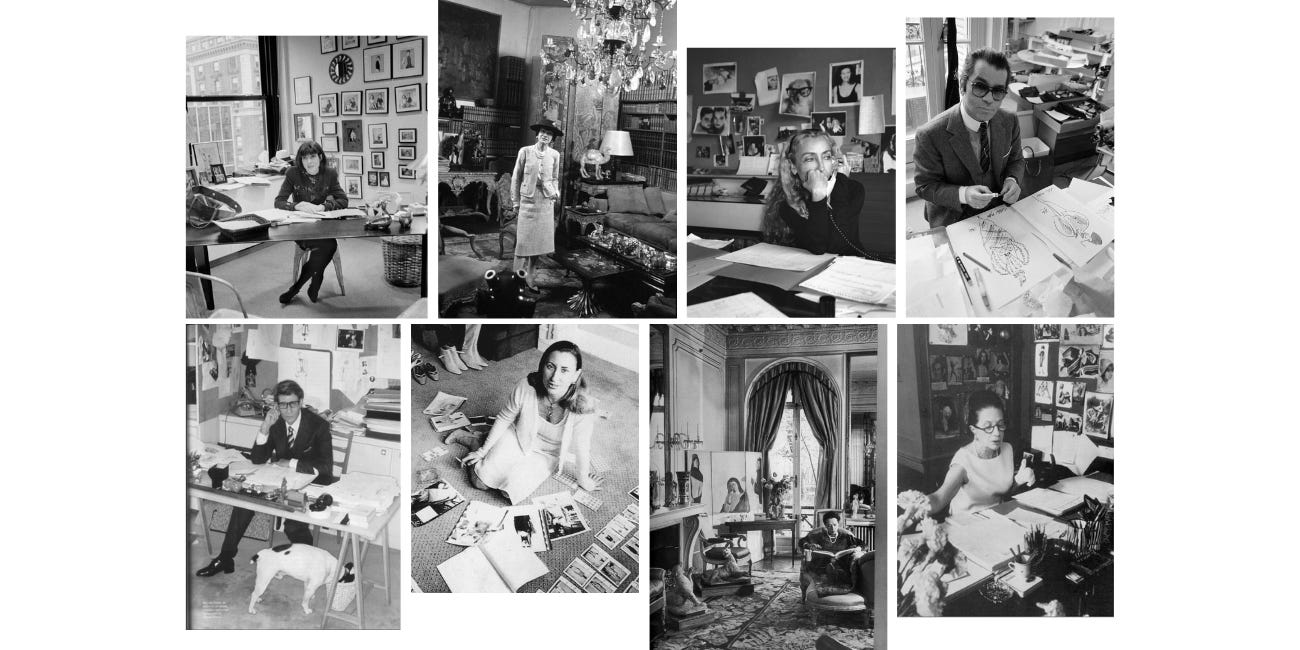
Taste has become the most talked about quality in fashion right now.
The tastemaker is having a moment, and everyone wants to be one. Someone with niche expertise and point-of-view that can’t be bought. Podcasts are debating it, creators are defining it, entrepreneurs are paying a premium for it. And the entire internet is attempting to reconstruct Carolyn Bessette-Kennedy’s wardrobe in pursuit of it.
But it didn’t come from nowhere. Last year, a particular kind of fashion exhaustion set in. We saw it in our feeds, in our wardrobes, maybe even in ourselves. Everyone was looking the same, sounding the same, shopping the same. The algorithm served it and the market was ready to sell it. And somewhere along the way getting dressed stopped feeling like self-expression and started feeling like a performance.
Taste became the antidote, but the solution is starting to look a lot like the thing it was trying to solve. So how did we get here?
The capsule wardrobe in its original form was a genuinely useful idea. Not a product category or formula, but a methodology.
The concept, credited to stylist Susie Faux in the 1970s and later crystallised by Donna Karan’s Seven Easy Pieces in 1985, was simple. Edit your wardrobe down to pieces that are entirely yours, defined by your life, your body, your aesthetic. The emphasis was always on the possessive, your capsule. Not something prescribed, but something excavated, built by you, for you.
Then the market got hold of it.
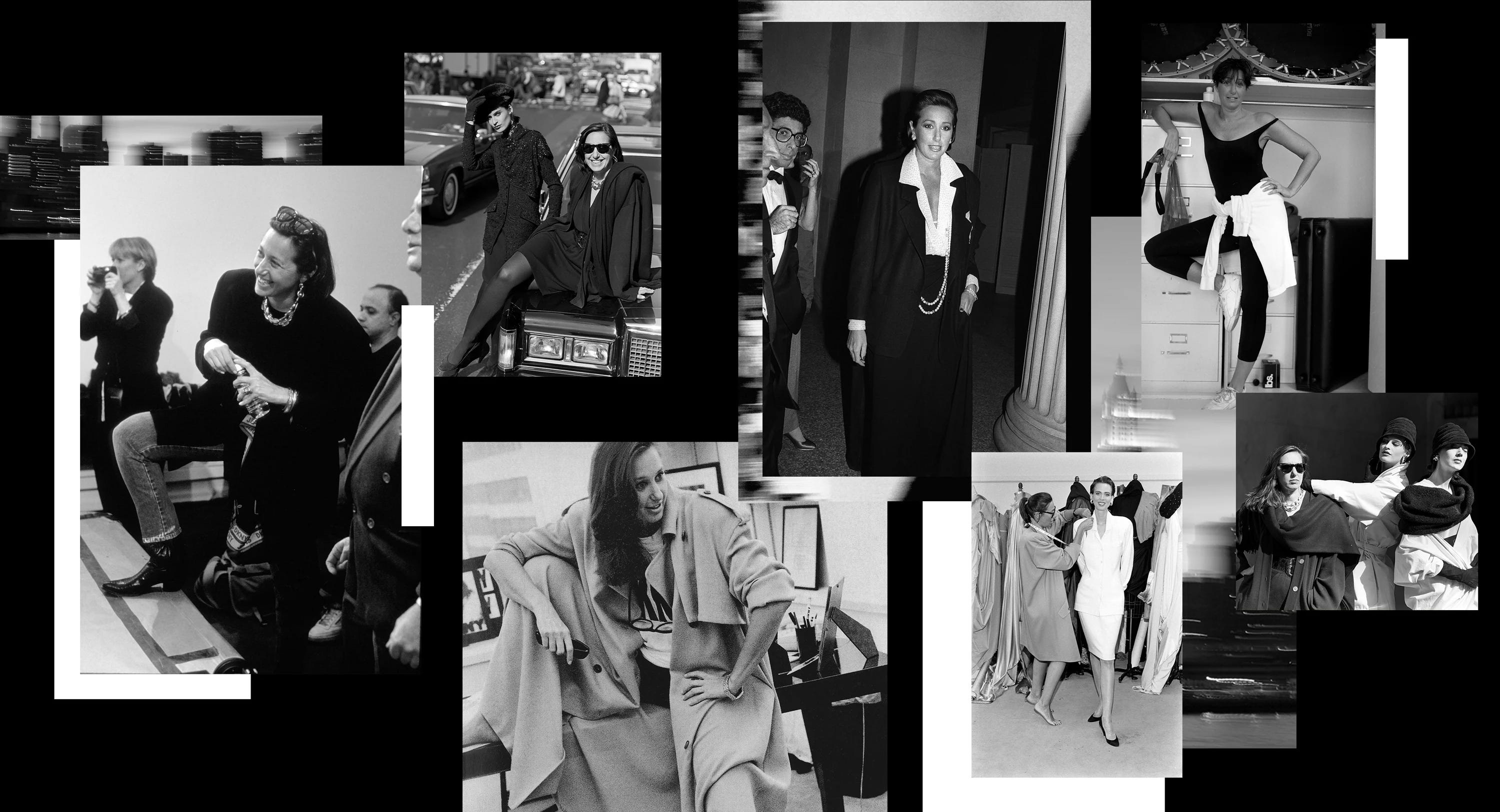
What followed was one of fashion’s most efficient acts of industrialisation. I know this because I was a part of it. My own womenswear brand ran on the capsule wardrobe formula. Our black blazer sold out continuously, despite every other brand offering an almost identical version at different price points.
The word “personal” quietly disappeared and what remained was a checklist disconnected from the individual it was supposedly built around. People followed the formula and ended up with wardrobes full of the right pieces that had nothing to do with them.
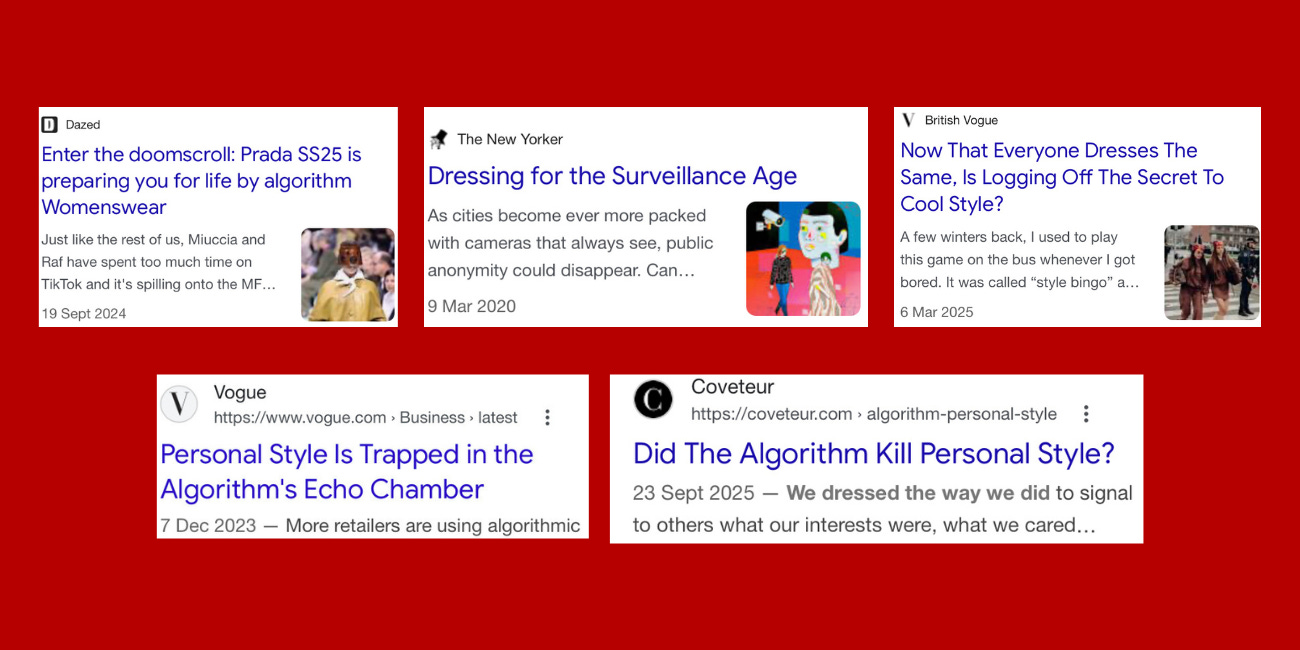
Following suit, the algorithm is now the most popular stylist in the world. Passive scrolling locks people into a feedback loop, served back to them. Miuccia Prada addressed this backstage at her SS25 show:
“We are directed by algorithms, so anything we like and anything we know is because other people are instilling it into us.”
I noticed it myself, shopping from the same narow palette of uninspired minimalism. Marie Kondo would absolutely disapprove of the lack of joy I felt from my closet.
With content optimisation being the goal, everything started to unsurprisingly look the same. Clothes selected for their performance on a screen rather than their feeling on the body. The more people dressed for the feed, the more the feed rewarded it, and the more the loop tightened.
So, people on the internet diagnosed themselves and prescribed their own cure.
Enter the taste conversation.
Develop your eye. Study references. Curate intentionally. Rise above the noise. The current argument is the next wave of cultural authority won’t belong to the influencer, it will belong to the tastemaker. The person with a genuine, considered, original, point of view.
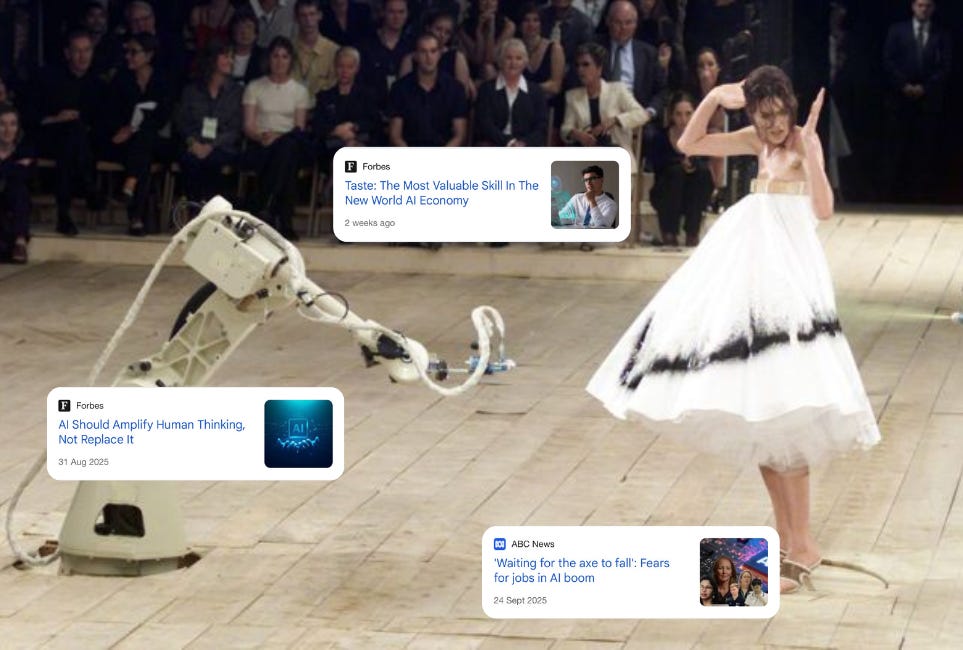
There’s also an economic reason this conversation is happening now. I recently watched a video of Australian entrepreneur Sophie Hood sharing that the positions she’s willing to pay for most in her business are the creative ones, (PR strategy, social direction, art direction) which are historically undervalued. The roles that traditionally commanded the highest salaries (lawyer, tax advice, market research) are the ones she uses AI for most.
Creative judgement, critical thinking, taste, these are skills a trained AI model cannot replicate. The urgency to develop taste isn’t just about looking interesting, it’s driven from a fear of needing to stay relevant
.The word taste can be divisive, as we’ve all seen this week on our FYPs. Prodcasters, creators, and consumers who are discussing taste don’t always agree on what developing taste actually requires.
Melbourne-based content creator and stylist Loui Burke addressed this tension. Burke made the distinction that taste is not class, even though historically the two have been intertwined. Access to travel, art, education, and time once made taste something only for the wealthy. But that access has broadened significantly with things like the internet, free art galleries, and more accessible travel.
What hasn’t changed is the commercial incentive to keep people out of the conversation entirely. Burke explains that in a market built on trend cycles, a consumer who has developed genuine taste is a harder sell. Brands don’t benefit from people who know exactly what they want and why, they benefit from people who don’t. If the taste conversation feels elitist, it’s worth asking who benefits from believing that.
There is a real case for developing taste. The problem is what’s being packaged and sold as the way to develop it.
Taste itself has become a content strategy.
There is now an entire genre of content dedicated to helping you develop your eye. Watch this, read that, study these references, visit these places, own these objects. The message is “develop your own perspective,” but what’s delivered often looks more like a curriculum. And the moment taste becomes something you can teach step-by-step is when it stops becoming yours. Founder and content creator Tamsin Wong puts it perfectly:
“Copying other people that you think have good taste is not a shortcut to having good taste yourself.”
When you get the same output from thousands of people who followed the same syllabus, the antidote becomes the next version of the problem. Which is exactly what happened to the capsule wardrobe.
This is what I like to call the taste trap.
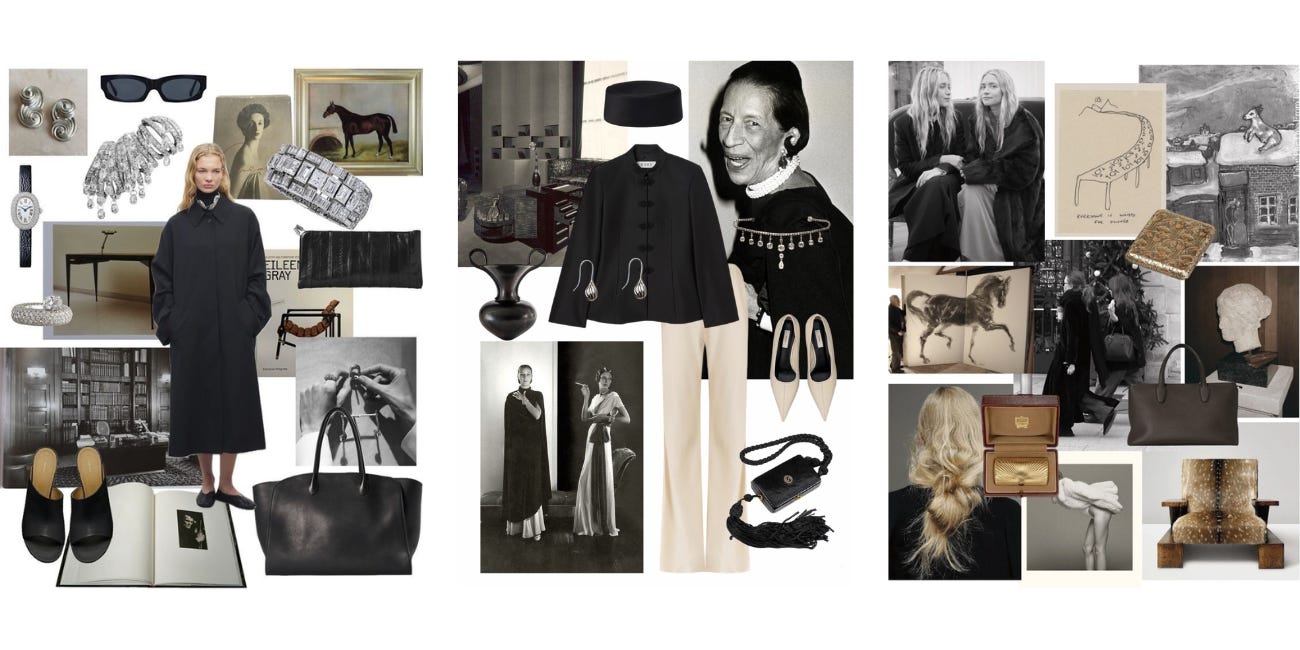
Tastemakers didn’t build their aesthetic by following a framework. They built it through years of mostly unconscious accumulation - returning to the same references without knowing why, developing instincts through experience, making mistakes and learning from them. If we look at how tastemaker content is made, people studied the output, reverse-engineered the patterns, and packaged them into a formula. The audience follows the map and wonders why they didn’t arrive at the same destination.
The catch is the destination was never on the map, because taste forms inside you.
It forms through experience - borrowing from your grandmother’s wardrobe and hearing the stories behind each outfit, deciding to read a book about clouds because they’ve always interested you (a true account from my sister-in-law), learning about different cultures from friends who grew up in other countries. Allowing curiosity, intentionality, and discernment to guide you.
Taste is almost autobiographical, it’s your life, expressed through your eye. That’s the joy of it. It requires boredom. Not the performative kind, actual empty space where your own preferences can surface without competition.
The algorithm replaced that space with content, and content always carries someone else’s conclusions. Tamsin explains:
“So much of developing good taste comes from friction… If you are terrified of trying new things or experiencing said friction… of course you’re just going to fall in line and only wear and do what you think is acceptable, dictated by algorithms and what you’ve seen on the internet.”
The resolution isn’t a reading list, or a set of references, or a more sophisticated version of consumerism. It’s the willingness to sit with the question before reaching for someone else’s answer. To make the wrong purchase and pay attention to why it was wrong. To admire Carolyn Bessette-Kennedy’s wardrobe without trying to replicate it - because admiration is where taste begins, and copying is where it ends.
The capsule wardrobe didn’t fail because the idea was wrong. It failed because it got separated from the most important word in the original premise: your wardrobe. The individual was removed from the equation before the equation was solved.
The taste movement is making the same move. The search for an original eye is being outsourced, and that’s the problem.
Tastemaker content doesn’t help you find your taste. It helps you perform someone else’s version of it. Yours is still waiting. It just needs space to surface.
Thank you for reading Language of Fashion.
The voices who helped shape this piece can be found below (in order of mention):
Sophie Hood, entrepreneur & founder of Seoul Tonic
Loui Burke, content creator, stylist, & design educator
Tamsin Wong, content creator & founder of The Rhubarb Society
Lastly, Zara Wong from Screenshot This, published a newsletter on taste that I really enjoyed reading, (and would have likely referenced if I hadn’t already finished writing this piece). She defines what taste actually is and the curiosity needed to develop it. You can find it here.
Just stumbled on this and it’s brilliant, love the nuance and the concept of the taste trap. Just subbed, excited to read more 💌
This is brilliant and so aligned with a lot of conversations I have been having lately. People want everything to be instant and quick. And as you mentioned developing taste takes real time and trial and error. I'm not sure if most will be willing to do what it takes to curate an authentic taste but it's absolutely the journey that I'm on. I hope more will join!! Thank you for this!